Dr. Anton Treuer -- Everything You Wanted to Know About Indians but Were Afraid to Ask Summary
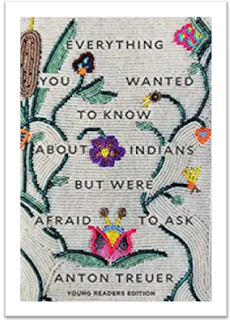
Everything You Wanted to Know About Indians But Were Agape to Ask,
Young Readers' Edition
Written by Anton Treuer (Ojibwe)
Published by Levine Querido
Published in 2021
Reviewed by Jean Mendoza
Review Condition: Highly Recommended
Anton Treuer's originalEverything You Wanted to Know About Indians But Were Afraid to Ask was published in 2012. Many people, myself included, hoped there would shortly be a version for young people. And at last, there is, and it's getting good critical attention, including a Kirkus starred review. Hither'south what its publisher Levine Querido says nearly the book:
From the acclaimed Ojibwe writer and professor Anton Treuer comes an essential book of questions and answers for Native and not-Native young readers akin. Ranging from "Why is in that location such a fuss almost nonnative people wearing Indian costumes for Halloween?" to "Why is it called a 'traditional Indian fry bread taco'?" to "What's it similar for Natives who don't await Native?" to "Why are Indians then often imagined rather than understood?", and beyond, Everything You Wanted to Know About Indians Merely Were Afraid to Ask (Young Readers Edition) does exactly what its title says for young readers, in a style consistently thoughtful, personal, and engaging.
This is AICL's "short-and-sweet review," with 4 reasons I retrieve teachers, librarians, and parents should read this book and share it with teens.
Reason Ane for recommending Everything You Wanted to Know: Accessible format and logical system
Questions are grouped by general discipline, starting with Terminology and proceeding through such topics equally History, Powwow, Politics, and Economics. The book'southward Conclusion, "Finding Ways to Brand a Deviation," tells how, offset in 1967, several non-Native people in Bemidji, MN, followed the pb of Native residents of the area to combat the blatant systemic racism directed against Native people at that place. I found it to be a moving and encouraging story, and a expert way to end the book -- when many readers are wondering, "Now that I've had my questions answered, what can I do to make things amend?" (I put that phrase about following the pb of Native people in assuming because Treuer wants to be clear that non-Native people need to understand that true back up consists of the support that Native people say they need.)
Reason two: Multiple potential uses.
For individual use, Everything is a handy reference for people seeking answers to their own questions, or looking for concise means to correct others' mistaken ideas.
The book besides is a skillful base for group conversations. I was able to participate in a teachers' professional development study circle based on Everything in Fall 2021, led past staff of the Illinois State Museum. Thoughtful discussions grew from our responses to the facilitators' questions such equally, "What surprised you in what you read?" and "How did you feel most what you learned?"
I can picture teens engaging with the book, guided by similar prompts. If whatever AICL readers endeavor facilitating such a grouping with teens, please allow us know how it goes.
Reason three: Presentation of varied perspectives
Treuer makes clear that there'due south no monolithic Native Culture or history to consult in most matters. Single, definitive answers to some questions simply exercise not exist. Just that doesn't mean differences are merely matters of opinion. The author cites sources throughout the volume, and readers can look at those and acquire. And Treuer's sense of sense of humor helps go his points across.
Reason four: Respect for Ethnic activism every bit rational and necessary
The writer describes situations when he individually opposed beliefs that was anti-Indigenous, likewise as resistance actions that involved thousands, such equally Continuing Stone. "Indian" mascots are nevertheless present and problematic in schools around the US, and he talks nigh those, also.
I think readers will peculiarly appreciate that he emphasizes the need for collective action for social justice. For example, he mentions that the murder of George Floyd past a police officer took identify in a community with a large Native population, many of whom had no doubt that the Black Lives Matter movement was grounded in reality, because they take experienced and seen similar treatment of black and brown people by law enforcement for generations.
Bonus reason to recommend Everything You lot Wanted to Know Near Indians simply Were Afraid to Inquire: That comprehend. No, a gorgeous embrace isn't sufficient reason to recommend a volume, just .... just look at it! The beading is the work of Jana Schmieding (Cheyenne River Lakota Sioux), whose other talents also include writing and acting. You may have seen her in the lead role on the sitcom "Rutherford Falls." And she tin bead. This, I call up, is essential reading for anyone in the field of teaching. And librarians. And any non-Native person who has been exposed to the dominant mistaken ideas about Ethnic peoples. In other words, pretty much anybody.Everything You Wanted to Know About Indians But Were Afraid to Inquire, Immature Readers' Edition, is packed with data for anyone. It can too be a source of support and affirmation for young Native readers. Get it for your schoolhouse/classroom/library!
Dr. Anton Treuer -- Everything You Wanted to Know About Indians but Were Afraid to Ask Summary
Source: https://americanindiansinchildrensliterature.blogspot.com/2022_01_16_archive.html
0 Response to "Dr. Anton Treuer -- Everything You Wanted to Know About Indians but Were Afraid to Ask Summary"
Post a Comment