How Many Babies Are Born With Genetic Disorders
Every year, nigh seven.9 million infants (vi% of worldwide births) are born with serious birth defects. With the causes of over 50% of birth defects unknown, how do nosotros diagnose and prevent them?
Every year, an estimated 7.ix one thousand thousand infants (6% of worldwide births) are born with serious birth defects. Although some built defects tin can be controlled and treated, an estimated 3.two 1000000 of these children are disabled for life. Moreover, nascence defects are the leading crusade of infant mortality in the United States. But where do these defects come from? Although some nativity defects are inherited, others are a product of harmful environmental factors known equally teratogens, and still others are multifactorial, resulting from a circuitous interaction of genetic and environmental influences. Nonetheless, in approximately one-half of all nascency defect cases, the causes are unknown (Christianson et al., 2006).
Genetic causes of birth defects autumn into three general categories: chromosomal abnormalities, single-gene defects, and multifactorial influences. Prenatal environs can play a major part in the development of defects in all three categories, especially those linked to multifactorial causes.
Chromosomal Abnormalities

A person'due south genetic makeup is determined at conception. It is then, during the nuclear events of fertilization, that the genetic causes of many nascency defects are determined. For example, chromosomal abnormalities, or large-scale duplications or deletions of chromosomal segments or entire chromosomes, can become apparent during this period. Many zygotes that carry such abnormalities exercise non develop into embryos, but amongst those that are carried to term, trisomy 21 (Down syndrome), trisomy 13 (Patau syndrome), and trisomy 18 (Edwards syndrome) are the most frequent birth defects. Embryos with these iii weather volition develop severe disabilities regardless of the environmental factors associated with the pregnancy.
Unlike Downwardly syndrome patients, who usually have a relatively long life span, children with Patau and Edwards syndromes often dice before long after nativity (March of Dimes, 2006). Individuals diagnosed with Patau syndrome suffer from neurological problems, mental and motor deficiencies, and polydactyly (Effigy i), equally well equally middle, heart, and spine defects (Patau et al., 1960). Those built-in with Edwards syndrome suffer mental retardation, breathing and feeding difficulties, delayed growth, and malformations of the kidneys, intestines, and heart (Edwards et al ., 1960; Van Dyke & Allen, 1990). Thankfully, both of these devastating syndromes are rare.
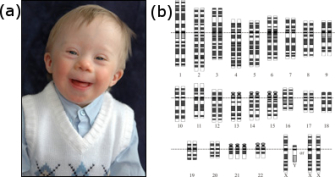
Effigy 2: Primary Down syndrome is acquired past the presence of iii copies of chromosome 21.
(a) A kid who has Downwardly syndrome. (b) Idiogram of a person who has primary Down syndrome.
(a) © 2006 iStock.com/JSCook. (b) National Institutes of Wellness.
Down's syndrome, on the other hand, is by far the most common chromosomal aberration, affecting 1 in 800 babies. The run a risk of having a child with this condition increases with maternal age, rise exponentially after a adult female reaches age 35. For instance, in young mothers, the frequency of trisomy 21 is about ane in 2,000, but this frequency rises to 1 in 100 when a woman is 40 and to 1 in 12 when she is l years old (Figure 2). People who have Down's syndrome suffer from moderate to severe mental retardation and a broad multifariousness of health issues, including heart defects, leukemia, and Alzheimer's disease. The severity of these defects varies widely, nevertheless, and the majority of people with Downward syndrome live semi-independent lives, with an average life expectancy of 56 in the United States (Eyman et al., 1991). Aneuploidies such as Down syndrome can generally be detected by the presence of additional chromosomes or chromosome translocations in a karyotype or FISH profile.
Single-Gene Defects
Equally opposed to chromosomal abnormalities, single-factor defects are usually inherited. For case, phenylketonuria (PKU) is a heritable condition caused by the malfunction of the PAH enzyme that breaks downward the amino acrid phenylalanine. Because this enzyme is coded for past the PAH factor on chromosome 12, PKU falls under the category of single-gene defects.
Interestingly, many unmarried-gene defects are variably prevalent among unlike racial and ethnic groups. For instance, sickle-cell anemia (a disorder of the hemoglobin) is almost mutual among people of African, Indian, and Mediterranean descent, whereas Tay-Sachs and Sandhoff diseases (both of which bear upon the nervous system) occur about frequently amidst Ashkenazi Jews. Tay-Sachs and Sandhoff diseases are both caused by a lack of the protein hexosaminidase, which controls the levels of fatty buildup in the encephalon. Specifically, autosomal recessive mutations in the HEXA factor on chromosome 15 cause various forms of Tay-Sachs, while the presence of a mutated HEXB cistron on chromosome 5 causes Sandhoff. These disorders mainly affect young children, who typically die during the first few years of life from progressive neural degeneration.
Multifactorial Influences
In certain cases, a combination of genetic mutations and teratogens leads to the development of multifactorial nascence defects. Although the exact causes of virtually multifactorial disorders are poorly understood, doctors can often identify common trends among similar conditions. Folate deficiency, for case, appears to play a role in diverse malformations of the neural tube, but the cumulative causes of such malformations and their relative contribution are rather complex. Neural tube defects accept also been linked to trisomy 18, numerous mutations in the genes necessary for the development of the nervous system, and exposure to certain epilepsy drugs. Of the dissimilar forms of neural tube defects, a condition known equally anencephaly is arguably the well-nigh astringent. Anencephalic babies lack most of their encephalon and are often stillborn or die soon after nascence. Spina bifida is a (relatively) less astringent defect of the neural tube characterized by a serial of deformities that are associated with incomplete enclosure of the spinal string past the twenty-eighth day of evolution. The exposed spinal string and the surrounding tissues are usually sealed surgically soon subsequently birth, but the neurological effects, including partial paralysis and loss of bladder command, oftentimes last a lifetime.
Of course, not all nascence defects have such profound consequences. Consider, for example, crack lip and palate; this is a multifactorial nascency defect that, if left uncorrected, can create difficulties with eating and speech. Children born with cleft lip usually undergo corrective surgery at an early age. Although genes definitely play a role in the evolution of this defect, environmental factors, including smoking and the apply of antiseizure drugs, have been associated with a greater take chances of bearing a child with cleft lip and/or palate (Ericson et al., 1979; Knight & Rhind, 1975).
Prenatal Environment
It is difficult to overemphasize the importance of prenatal environment to a developing fetus. Indeed, a pregnant mother's wellness, diet, and level of exposure to toxins and ecology pollutants all have a straight issue on fetal development. For example, i of the nigh highly publicized cases of widespread toxin exposure associated with a pronounced increase in birth defects involves the use of Agent Orange, an herbicide that contains the poisonous substance dioxin, by the U.S. Army during the Vietnam War. Since the terminate of that disharmonize, the frequency of nascency defects in those areas exposed to dioxin has risen to most three times the norm. Dioxin, a production of industrial processes, disrupts the function of nuclear receptors and interferes with jail cell signaling. Moreover, dioxin is fatty soluble and takes a long fourth dimension to degrade, which means information technology tin build up over fourth dimension in soil, in water, and in the fatty tissue of animals that humans eat.
Other environmental toxins that might harm a fetus are taken voluntarily, such as drugs, alcohol, and cigarettes. For instance, excessive maternal alcohol consumption often causes fetal alcohol syndrome, which is characterized past defects of major organs, abnormal facial features, and mental retardation. Similarly, smoking during pregnancy has been linked to an increased risk of stillbirths, low birth weights, and scissure lip and/or palate (Ericson et al., 1979; Knight & Rhind, 1975). Although studies accept not demonstrated a strong correlative link between a high incidence of birth defects and consumption of moderate amounts of alcohol and tobacco, doctors strongly recommend complete abstinence from smoking and drinking during pregnancy.
Still another major factor linked to aberrant prenatal development is poor diet during pregnancy. Sure foods, such every bit seafood with high mercury content, should be consumed in moderation, whereas other high-vitamin foods are encouraged. Dietary supplements, such as folate (vitamin B9) and iodine taken before and during the early on stages of pregnancy, tin aid in evolution of the neural tube. It is important to understand, however, that skilful nutrition and a healthy lifestyle do not ensure a healthy child, although they do play a protective role in certain individuals.
Limiting the Frequency of Birth Defects
Although some built defects cannot be prevented, improvements in health care, nutrition, and education can reduce their frequency and phenotypic severity. The increasing utilise of prenatal genetic screens and preimplantation genetic diagnosis (PGD) is also helping limit the frequency and the severity of birth defects. These advances are a great tool, but they also have a surprising downside. Specifically, deleterious genetic mutations that take a recessive pattern of inheritance volition remain in the population if the parents seeking PGD are allowed to select only healthy embryos to be carried to term. The electric current use of this technique, yet, is limited to the select few who tin can afford it, then this phenomenon will not have a noticeable bear on on the overall population for quite some time.
References and Recommended Reading
Christianson, A., et al. March of Dimes Global Report of Nativity Defects: The Hidden Cost of Dying and Disabled Children. (2006) (accessed August 28, 2008).
Edwards, J. H., et al. A new trisomic syndrome. Lancet 1, 787–790 (1960)
Ericson, A., et al. Cigarette smoking as an etiologic factor in crack lip and palate. American Journal of Obstetrics and Gynecology 135, 348–351 (1979)
Eyman, R. 1000., et al. Life expectancy of persons with Downwardly syndrome. American Periodical of Mental Retardation 95, 603–612 (1991)
Knight, A. H., & Rhind, E. G. Epilepsy and pregnancy: A study of 153 pregnancies in 59 patients. Epilepsia xvi, 99–110 (1979)
Korkko, J., et al. Widely distributed mutations in the COL2A1 gene produce achondrogenesis type II/hypochondrogenesis. American Journal of Medical Genetics 92, 95–100 (2000)
March of Dimes. Chromosomal abnormalities. (2006) (accessed Aug. 28, 2008)
Patau, Thou., et al. Multiple congenital anomaly acquired past an actress autosome. Lancet 1, 790–793 (1960)
Van Dyke, D. C., & Allen, Yard. Clinical direction considerations in long-term survivors with trisomy eighteen. Pediatrics 85, 753–759 (1990).
How Many Babies Are Born With Genetic Disorders
Source: http://www.nature.com/scitable/topicpage/birth-defects-causes-and-statistics-863
0 Response to "How Many Babies Are Born With Genetic Disorders"
Post a Comment