Nac Drops N-acetyl-carnosine Anti-aging Antioxidant Lubricant Eye Drops Be the First to Review This
The Cataract Cure about L-carnosine and N-acetylcarnosine
Dr. Kyriazis is one of Britain's height anti-crumbling physicians and is internationally recognised equally a pioneer in the field. He is a bio-gerontologist with a medical caste and postgraduate degrees from King'southward College, London and the Royal College of Physicians. He has written many books for both the medical professional and the public alike and his articles accept been widely published. In 1991 Dr. Kyriazis founded the British Longevity Society, 1 of the earliest societies in the field notwithstanding operating today.
Prologue
Dr. Marios Kyriazis brings a wealth of medical expertise to one of the nigh of import breakthroughs in recent times to help gainsay a disease called 'senile cataract,' a affliction that affects ane in 5 people over the age of 55.
In the past, the only treatment available for this chronic condition was surgery, which by its very nature can lead to serious complications. We must likewise consider that the replacement of a natural lens with a plastic one leads to a loss in accommodation; in brief a plastic lens is non every bit good as a natural 1.
But at present other non-surgical treatments are available, in item the Russian evolution of Northward-acetyl-carnosine. In clinical trials this middle-driblet treatment has shown dramatic and impressive results in treating age related cataracts.
Furthermore, The Cataract Cure also covers other associated middle disorders including;
- Glaucoma
- Macular degeneration
- Infection of the cornea
- Dry out eye syndrome
- Figurer vision syndrome
- Eyestrain
- Blurred vision
The Cataract Cure is a resource for all persons interested in knowing about alternative approaches to eye intendance, approaches that are still proven, scientific and based in clinical experience.
Disclaimer
The information contained within this book is based on the experience and research of the author. Information technology is not intended to substitute for a medical consultation and any effort to diagnose or treat a disease should only be done nether the guidance of a medical professional.
The publisher does not advocate the use of any particular protocol, simply believes the information should be made available to the public. The publisher therefore cannot be responsible for any agin furnishings or consequences arising from the utilize of any suggestions or procedures that are discussed in this book.
Any determination made in purchasing goods and/ or services equally a result of information obtained within is your sole responsibility. We will not be liable to any customer for any information supplied in this publication and it is provided on an 'every bit is' basis.
Should the reader have any questions apropos the preparations or procedures mentioned herein, the publisher strongly recommends consulting with a professional person wellness care advisor.
Copyright 2010
All rights are reserved, no role of this publication may exist used or reproduced by an means, graphic, electronic or mechanical, including photocopying, recording, taping or past whatever information storage retrieval system without the written permission of the publisher- except in the instance of brief quotation embodied in critical articles and reviews.
IAS, PO Box 19, Sark GY9 0SB, Not bad Britain
Contents
- Foreword
o By Phil Micans, MS, PharmB
- Affiliate one: Introduction
o Carnosine
o Metformin
o Aminoguanidine
o Melatonin
o Cataracts
o Glaucoma
o Macular degeneration
- Chapter 2: Cataract
o Background
o Bug
o Nutrients
- Chapter 3: N-acetyl-carnosine eye-drops
o Lipid peroxidation
o Action and properties
o Research
o Photographs
o Other indications
- Chapter four: Composition and purity
- Affiliate 5: Further information
o FAQs
o Instance studies
o Testimonials
o Conclusion
- Chapter half-dozen: Resource guide
o Glossary
o Suppliers
o References
o Websites
o Biography
o Reviews
Foreword
As a researcher my work has taken me effectually the globe in search of new and exciting developments in the hunt for both preventative and curative therapies.
The earth has many innovative products and technologies that are not well known and from fourth dimension to time a particularly heady development come to the fore; Northward-acetyl-carnosine eye-drops for cataract are only such an instance.
In this publication Dr. Kyriazis highlights the background to its development and its studies and as well looks at the clinical applications that make these eye-drops special. In add-on, his patient examples and testimonials bring that intimate feeling that makes a discovery something personal and somehow even more important.
With an ever increasing 'older' population the incidences of age-related disorders such as senile cataract are ever more prevalent. Every bit Dr. Kyriazis highlights in 'The Cataract Cure' this new enquiry has proven that an centre-drib can wearisome, arrest and even reverse cataracts. Therefore, information technology not simply represents an splendid example of 'antiaging medicine' at its all-time, it is also an important breakthrough for center care.
Dr. Kyriazis volume doesn't 'just' discuss the topic of cataracts, but includes additional information regarding other class leading therapies and nutrition; procedures that can better and ameliorate many other troubling eye-sight problems including glaucoma and macular degeneration.
My recommendation is that anyone who is concerned most their failing eyesight and vision difficulties should digest and act upon the information presented here.
Phil Micans, MS, PharmB
——————————————————————————–
Affiliate 1: Introduction
History tells us that we now live longer than always earlier. Scientific advances have ensured that many illnesses accept been successfully eliminated and newer therapies are beingness discovered to deal with existing illnesses. Within the next twenty years nosotros may experience an fifty-fifty more dramatic extension of the human life-bridge, made possible by discoveries in the field of genetics, stem cells, growth factors, calorie brake mimetics and nanotechnology. Until that moment arrives, we need to deal with existing historic period-related disorders as all-time we can, and to be able to do this, we demand to know exactly how aging works.
Most anti-crumbling researchers and physicians accept that a major factor involved in aging is damage caused past gratis radicals. These are a grouping of simple compounds with an electron missing form their chemicals structure. The lack of electron makes free radicals very unstable. Due to reasons based on chemistry and chemical laws, free radicals need to obtain the missing electron from somewhere, then they must seek out other molecules from which they can acquire an electron.
Examples of gratis radicals are:
- Superoxide radicals
- Hydrogen radicals
- Hydroxyl and nitric oxide radicals
These reactive molecules destroy other molecules around them causing what we now telephone call 'aging'. Costless radicals affect every organ of your torso, constantly. Past the fourth dimension you have finished reading this sentence, your Deoxyribonucleic acid, proteins and cells take already been, minutely simply irreversibly, damaged.
Therefore, it is important to go on complimentary radicals under control, and Nature has made arrangements for this. We carry inside united states a multifariousness of antioxidants, natural chemicals which mop up free radicals and destroy them, keeping impairment low. The trouble is, with the passage of time, the effectiveness of these antioxidants worsens, and and so nosotros get unable to fight free radicals effectively. In this way, age-related harm accumulates until the time of death.
Autonomously from free radicals, some other important cause of aging is glycation. During everyday metabolism, natural chemicals in your body such equally glucose, fructose, aldehydes and ketones may attach themselves onto your proteins, during a process chosen glycation. This reaction is besides sometimes chosen the Maillard reaction. It results in a glycated protein, i.e. a protein conveying saccharide (or similar) molecules on it. This glycated protein may and then react with any other proteins resulting in irreversible bonding betwixt the ii. This bonding process is named 'cross-linking.'
Afflicted molecules can be anything from collagen and elastin (establish in your pare, arteries or other internal tissues), to enzymes and proteins of the immune system. Facilitators during the cross-linking procedure are the carbonyl groups which act similar glue, fixing the two proteins together. Carbonyls are fragments of chemicals which are formed as a result of a sugar (or an aldehyde or a ketone or a gratis radical) reacting with amino acids on a protein. Besides, carbonyls tin exist formed in other situations involving fats or Deoxyribonucleic acid. And so, carbonyls may non just cause protein-to-protein cross-linking, but also protein-to-DNA, or poly peptide-to-lipid cross-linking, which is as damaging to your body.
Cross-linking results in formation of large insoluble amounts of damaged proteins in the tissues, including the eye. These damaged proteins are called AGEs (Advanced Glycation Stop products) and may then keep to combine with complimentary radicals and cause yet more than tissue injury (this is called 'chronic oxidation'). Although a steady rate of AGE formation happens every bit a result of normal aging (starting after the age of 20), formation of AGEs is accelerated during diabetes. AGEs and then block activities within the cells, stimulate cells to produce more than complimentary radicals (such as superoxide and nitric oxide), and activate toxic chemical such every bit Tumour Necrosis Gene blastoff (TNF-a) and interleukin vi. In this way, AGEs are contributing to age-related chronic diseases or fifty-fifty cancer.
Chronic diseases which tin can be caused by glycation and cantankerous-linking are:
- Diabetic complications
- Poor immunity
- Increased run a risk atherosclerosis and high blood pressure
- Alzheimer's dementia
- Kidney harm
- Pare aging
- Cataract (glycation, cantankerous-linking and AGEs are particularly relevant to the eye where they may crusade pregnant harm equally will be described below).
At that place are commercially available blockers of cantankerous-linking (antiglycators). Examples of these include carnosine, aminoguanidine, metformin, acarbose, and pyridoxamine. Some of these (like acarbose and metformin) are already in use as drugs against diabetes, but new research coming to light is at present emphasising their additional anti-cross-linking furnishings. However, only carnosine (under the form of North-acetylcarnosine) can exist given in heart drops form for handling of chronic eye conditions.
Three examples of effective anti-glycators are:
1. Carnosine
This combination of the amino acids beta alanine and L-histidine is a naturally-occurring agent found in muscle and nervous tissue. Carnosine has been hailed as one of the nearly promising cross-link inhibitors, and and so information technology has been used against cataract as you volition soon see. Information technology has multiple actions and every bit such it has been called a pluripotent amanuensis. One way carnosine works is by scavenging for gratuitous carbonyl groups. It is i of the few cross-link inhibitors thatis not only active confronting protein-to-poly peptide cross-linking but as well against protein-to-DNA cross-linking.
Carnosine has a directly antioxidant action, and it also protects and activates many other antioxidants, such every bit glutathione. Information technology is a potent chelator of heavy metals, mopping-up any toxic metallic ions in your torso which may result in accelerated free radical attack. Finally, it has a possible, yet unconfirmed, bond-breaking capability past dissolving sure bonds (S-S bonds) on cross-linked proteins. In measurements of arterial wall flexibility, carnosine seems to be able to relax the arterial wall and thus improve claret catamenia. This particular benefit of carnosine may exist related to its ability to stimulate nitric oxide, a molecule that relaxes the muscles within the arteries.
Several experiments have highlighted carnosine's power to reduce gratis radical and glycation metabolism, both in humans and in animals. 1 of the most of import developments regarding carnosine is its ability to prevent and cure age-related cataract, and possibly glaucoma and other chronic center conditions. In this respect the course of carnosine used is N-acetylcarnosine. This curative action of carnosine is perhaps related to its ability to stimulate elimination of damaged proteins from the heart.
The dose of oral carnosine is anything from fifty mg to 300 mg a twenty-four hours, upwardly to 500 mg to 1500 mg a solar day. With higher doses, there take been occasional reports of allergic reactions. Carnosine can besides be obtained from a meat rich diet, particularly from chicken breast, rabbit, pheasant and other game (peculiarly sprinting animals).
The interest in the utilise of carnosine and its derivatives for the treatment of cataract has been increasing over the past three years. Writing for a major peer-review journal, scientists from the Department of Ophthalmology, Christchurch Infirmary, Christchurch New Zealand, have commented: "Since the concluding major review of medical handling of cataract the search for an anti-cataract agent has avant-garde on many fronts. Some anti-cataract drugs, such equally carnosine, take at present reached clinical trials and showed encouraging results that warrant further investigation. The discovery of an constructive medical treatment for cataract is likely to brand global touch on on eye health."
Reference: Toh T, Morton J, Coxon J, Elder MJ. Medical treatment of cataract. Clin Experiment Ophthalmol. 2007;35(7):664-71.
two. Metformin
Metformin is a frequently used drug used against diabetes (both confronting the insulin-dependent and confronting the non-insulin-dependent varieties). It tin also lower cholesterol, reduce torso fat, beef-up antioxidant defences and inhibit glycation. It limits the formation of AGEs, particularly those affecting collagen.
Recent experiments show metformin to have widespread activities as a cross-link inhibitor. It reduces cross-linking of fibrin proteins which accept part in the clotting of claret. Exaggerated cross-linking of fibrin results in aberrant claret clotting and therefore an increased run a risk of thrombosis with consequent heart affliction or stroke.
There are no clinical studies evaluating metformin in cataract, but diabetic patients who are already on information technology are likely to exist receiving its antioxidant, antiglycating benefits. Moreover, because it helps improve the circulation of the blood (by reducing the risk of thrombosis), it may be additionally useful in centre diseases such as macular degeneration, cataract and glaucoma.
Metformin is a calorie restriction mimetic which ways it has many biological benefits associated with calorie restriction itself. Calorie restriction is the only proven method that can increase maximum lifespan, and reduces the likelihood of historic period-related weather condition, including cataract.
3. Aminoguanidine
An agent structurally similar to metformin is aminoguanidine. Every bit with the case of metformin, aminoguanidine also works by reducing the concentration of costless carbonyl groups. In detail, it is active against certain aldehydes which contribute to cross-linking. It is effective mainly during the early stages of glycation.
Aminoguanidine is a potent inhibitor of any cross-linking which is initiated by glucose molecules but not as constructive in situations involving ribose-related cross-linking. In any case, it prevents collagen cross-linking in tendons and peel, which shows its potential for prevention of muscle and articulation age-related stiffness, and skin ageing (wrinkles). It limits the development of diabetic complications in animals (including eye complications), and information technology has shown promising effects in improving diabetic kidney disease. As well, it is a weak copper chelator. Copper chelation is of import in Historic period-induced damage, as loftier amounts of gratuitous copper are more likely to increase Age-induced injury.
An additional activeness of aminoguanidine is that it prevents cross-linking betwixt lipoproteins (proteins conveying fat molecules) and therefore reduces the hazard of blockage of the arteries, particularly the small arteries that feed the small nerves of the heart. Information technology should, therefore, be of employ in eye conditions were blood supply is compromised. Experiments using aminoguanidine in eye drops class for prevention of cataract are currently nether fashion.
Apart from anti-glycators, certain other agents have specific and promising benefits on centre disease. One such agent is melatonin.
Melatonin in some age-related eye conditions
In the center, melatonin is produced in the retina, only product gradually declines with age. Adding actress oral melatonin supplements is believed to protect against many degenerative eye conditions. The presence of cell receptors for melatonin in the eye indicates that this substance has an of import physiological role to play in several functions related to vision.
It has been shown that melatonin (N-acetyl-v-methoxytryptamine) prevents free radical damage to the tissues and too it scavenges and neutralises gratuitous radical in the middle.
Electric current evidence suggests that melatonin may protect against eye diseases such equally cataract, keratitis, glaucoma, retinopathy and other injury to the eye. The cause of these conditions is thought to exist, partly, due to oxidation damage which causes loss of cells (apoptosis), and degeneration of retinal neurons. Gratuitous radicals such as nitric oxide in the eye neurons and superoxide in the mitochondria of the axons produce dangerous toxins such as peroxynitrite. Among the substances that have actions against peroxynitrite is besides melatonin.
As well see the paragraph beneath for further information of melatonin in the treatment of macular degeneration.
Cataract
In cancer patients undergoing radiotherapy, the effect of irradiation on the centre can be significant, contributing to a worsening of cataract. Yet, researchers from the Section of Radiation Oncology, Atatürk University, in Turkey have shown that melatonin supplements protect the lens of the optics from radiation-induced cataract formation. The researchers suggest that supplementing cancer patients with melatonin may reduce the risk of radiotherapy-induced tissue injury.
Glaucoma
With regards to glaucoma, current research suggests that it could reduce intraocular pressure and then it tin can exist of real help in this condition.
Reference: Mediero A, Alarma-Estrany P, Pintor J. New treatments for ocular hypertension. Auton Neurosci. 2009 11;147(1-2):14-9.
Note- this is believed to be due to melatonin's antioxidant effect, which is nevertheless being investigated.
Macular degeneration
Researchers from the Zhongshan Ophthalmic Middle, Sun Yat-Sen University in Red china have reported that melatonin can help reduce the progression of macular degeneration. It is well known that melatonin controls eye pigmentation and then regulates the amount of light that reaches the visual receptors in the eye.
These researchers studied 100 patients suffering from either the moisture or the dry form of macular degeneration. The patients were given 3 mg of melatonin every night, (the precise formula was designed by Dr. Walter Pierpaoli and also independent zinc and selenium in addition to the melatonin, it is called Melatonin Zn-Se or MZS™).
Subsequently a half dozen month period, the scientists found that the patients' visual vigil was stable, i.e. at that place was a slowing down of the natural worsening of the condition. The scientists said: "We conclude that the daily use of three mg melatonin [with zinc and selenium] seems to protect the retina and to delay macular degeneration. No significant side furnishings were observed. "
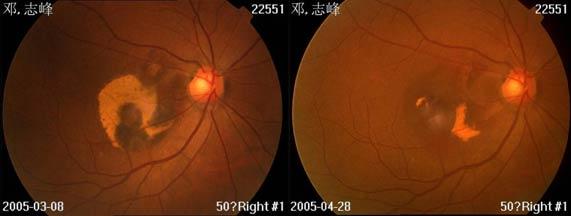
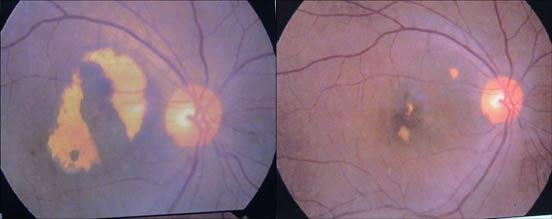
These photographs (fundus pictures) attest to the slowing and reversal of both moisture and dry forms of age related macular degeneration (ARMD). Patients took one MZS™ tablet (3mg melatonin, 50mg zinc and 50mcg selenium) nightly.
Meridian set: The left slide shows the eye of a 67 year one-time male earlier treatment, his vision had been deteriorating for two-years. The right picture shows the same middle ii-months afterwards after daily ingestion of one MZS™ tablet nightly. He now has stable visual acuity of 0.iii with remarkable improvements in sub-retinal macular hemorrhage.
Bottom prepare: The left slide shows the heart of a 71-twelvemonth old female with ARMD earlier treatment. The right slide is her eye after 6-months of one MZS™ tablet nightly. Her vision improved from 0.2 to 0.4 (every bit indicated in the correct slide).
Reference: Effects of melatonin in age related macular degeneration. Changxian Yi, Xiaoyan Pan, Hong Yan, Mengxiang Guo, Walter Pierpaoli. New York Academy of Science, book 1057, 385-392, December 2005.
A recent study by Austrian scientists confirms the antioxidant backdrop of melatonin with regards to the eye, commenting that patients with macular degeneration try to produce more melatonin as a defense mechanism against the status.
Reference: Schmid-Kubista KE, Glittenberg CG, et al. Daytime levels of melatonin in patients with historic period-related macular degeneration. Acta Ophthalmol. 2009;87(one):89-93.
So, to summarise, gratis radicals and glycation are two important causes of aging, and tin cause a variety of chronic diseases, including cataract and other degenerative eye diseases. Certain nutrients and drugs are at present commercially available, which may help protect against such chronic diseases.
Affiliate 2: Cataract
Age-related (senile) cataract is a chronic, progressive eye disease affecting the lens in the centre, resulting in reduced vision. The lens is a transparent, pale yellow structure made of special proteins (crystallins) and other clear cloth, allowing the low-cal to laissez passer through and focus onto the retina, so an paradigm tin be formed. It is found behind the pupil of the heart and it is surrounded by an elastic capsule. The lens is a relatively simple structure and it grows throughout life from the inside outwards.
When the lens is affected by age-related damage, it becomes opaque and cloudy, reducing the corporeality of calorie-free reaching the inside of the middle and and then vision is impaired.
Did y'all know?
Cataract is a Greek world, meaning 'waterfall'. Indeed, the aboriginal Greeks compared the visual damage of a patient with cataract to the difficulties in trying to encounter through a waterfall.
Cataract affects 1 in four people over the age of 65, and one in two people aged 80 and above. Nearly 28 000 new cases worldwide are reported every single 24-hour interval, and 17 million people across the globe are blind due to cataract. Operations to treat cataract cost the US lonely $three.5 billion a year, and 43% of visits to eye specialists in the United States are associated with cataract. Therefore, at that place is considerable involvement in finding ways to prevent the condition and reduce the brunt upon health-providers.
The problem is that in developing countries cataract remains, on the whole, untreated due to lack of resource. In such countries it is a major cause of blindness. It is impossible to provide enough eye surgeons to manage all the cases of cataract in developing countries, non only due to the high cost involved merely likewise due to lack of manpower.
Did you know?
Around 9 million people in developing countries (in Africa and Asia) are blind due to cataract. Put another fashion, one in every hundred residents of Africa is blind, and the frequency of the disease is increasing.
As we more often than not alive longer than ever before, historic period-related diseases such every bit cataract are now becoming more frequent and affect people for longer. Nonetheless, cataract does not only happen to older people. Younger groups are also affected. Apart from genetic causes of cataract, 2 well known causes are use of steroids and diabetes. As well, nutrition has been implicated as a cause. People who eat poor quality nutrient are at a greater hazard of cataract, and poverty is a gamble factor making cataract more probable. This may be because a diet which is poor in high quality vegetables, poly peptide and fruit does non provide plenty nutrients to prevent the costless radical damage to the centre.
You may remember from the give-and-take in Chapter i that gratuitous radicals and glycation cause proteins within the lens to adhere to each other, a process chosen cross-linking. This mass of aberrant proteins scatters the lite and does not permit it to pass through. The crystallins in the lens become abnormally distorted and can settle in different parts of the lens, for example the top, the middle, the exterior, or the entire lens, causing different types of cataract. What is important here is that an opaque lens is not a useful lens, equally the light must pass through it uninterrupted. Therefore, any treatment which reduces damage to crystallins is jump to upshot in effective clinical improvement of cataract.
From the nutritional bespeak of view, lack of antioxidants in the diet has been shown to worsen the risk of cataract and other centre diseases such as glaucoma. Patients with cataract are frequently found to exist deficient in antioxidants such as vitamin A, glutathione, lutein and zeaxant
pettiefackeffaced.blogspot.com
Source: https://antiaging-nutrition.com/articles/the-cataract-cure-about-l-carnosine-and-n-acetylcarnosine/
0 Response to "Nac Drops N-acetyl-carnosine Anti-aging Antioxidant Lubricant Eye Drops Be the First to Review This"
Post a Comment