Prior to Trade, What Was the Opportunity Cost to Produce 1 Clock in Denmark?
All our charts on Trade and Globalization
Trade has inverse the world economy
Trade has grown remarkably over the last century
The integration of national economies into a global economic organisation has been one of the most important developments of the last century. This process of integration, often called Globalization, has materialized in a remarkable growth in trade betwixt countries.
The chart hither shows the value of world exports over the period 1800-2014. These estimates are in abiding prices (i.e. have been adjusted to account for inflation) and are indexed at 1913 values.
This chart shows an extraordinary growth in international merchandise over the last couple of centuries: Exports today are more than xl times larger than in 1913.
You lot can click on the option marked 'Linear', on top of the vertical axis, to modify into a logarithmic scale. This volition help you run across that, over the long run, growth has roughly followed an exponential path.
Trade has grown more than than proportionately with GDP
The chart above shows how much more merchandise we have today relative to a century ago. But what almost trade relative to full economic output?
Over the terminal couple of centuries the world economy has experienced sustained positive economic growth, and so looking at changes in trade relative to GDP offers another interesting perspective.
The next chart plots the value of trade in goods relative to Gross domestic product (i.e. the value of trade trade as a share of global economic output).
Up to 1870, the sum of worldwide exports accounted for less than x% of global output. Today, the value of exported goods around the world is close to 25%. This shows that over the last hundred years of economic growth, at that place has been more than proportional growth in global merchandise.
(NB. In this chart you can add countries past choosing the option on the bottom left; or y'all tin compare countries around the world by clicking on 'Map' on the chart.)
Today trade is a fundamental role of economic activity everywhere
In today'south global economical system, countries exchange not simply concluding products, only likewise intermediate inputs. This creates an intricate network of economical interactions that embrace the whole world.
The interactive data visualization, created by the London-based information visualisation studio Kiln and the UCL Energy Establish, gives us an insight into the complex nature of trade. It plots the position of cargo ships across the oceans.
Trade generates efficiency gains
The raw correlation between trade and growth
Over the last couple of centuries the earth economy has experienced sustained positive economic growth, and over the aforementioned menses, this process of economic growth has been accompanied by even faster growth in global trade.
In a similar way, if we wait at country-level data from the last one-half century nosotros find that in that location is too a correlation betwixt economic growth and trade: countries with higher rates of Gross domestic product growth also tend to take higher rates of growth in trade every bit a share of output. This basic correlation is shown in the chart hither, where we plot average annual change in existent Gross domestic product per capita, against growth in trade (average annual modify in value of exports equally a share of Gdp).1
Is this statistical association betwixt economic output and trade causal?
Amongst the potential growth-enhancing factors that may come up from greater global economical integration are: Contest (firms that fail to adopt new technologies and cut costs are more likely to fail and to be replaced by more than dynamic firms); Economies of calibration (firms that can export to the earth face larger demand, and under the right conditions, they can operate at larger scales where the price per unit of production is lower); Learning and innovation (firms that trade gain more experience and exposure to develop and adopt technologies and manufacture standards from foreign competitors).2
Are these mechanisms supported past the data? Allow's have a look at the available empirical prove.
Causality: Evidence from cross-country differences in trade, growth and productivity
When information technology comes to bookish studies estimating the impact of trade on Gdp growth, the about cited paper is Frankel and Romer (1999).3
In this study, Frankel and Romer used geography every bit a proxy for trade, in order to estimate the affect of trade on growth. This is a classic example of the and then-called instrumental variable approach. The thought is that a country's geography is fixed, and mainly affects national income through trade. So if we observe that a land's altitude from other countries is a powerful predictor of economic growth (after bookkeeping for other characteristics), then the decision is drawn that it must exist because trade has an outcome on economic growth. Post-obit this logic, Frankel and Romer find prove of a strong impact of merchandise on economic growth.
Other papers accept practical the same approach to richer cross-country data, and they have found like results. A key instance is Alcalá and Ciccone (2004).iv
This body of show suggests trade is indeed one of the factors driving national average incomes (Gross domestic product per capita) and macroeconomic productivity (GDP per worker) over the long run.5
Causality: Show from changes in labor productivity at the firm level
If merchandise is causally linked to economic growth, we would await that trade liberalization episodes besides lead to firms condign more productive in the medium, and even brusque run. There is evidence suggesting this is frequently the example.
Pavcnik (2002) examined the effects of liberalized trade on plant productivity in the example of Chile, during the tardily 1970s and early on 1980s. She found a positive impact on firm productivity in the import-competing sector. And she as well found evidence of amass productivity improvements from the reshuffling of resources and output from less to more efficient producers. 6
Bloom, Draca and Van Reenen (2016) examined the impact of rising Chinese import competition on European firms over the flow 1996-2007, and obtained similar results. They constitute that innovation increased more in those firms most affected by Chinese imports. And they found evidence of efficiency gains through ii related channels: innovation increased and new existing technologies were adopted within firms; and aggregate productivity also increased because employment was reallocated towards more technologically advanced firms.7
Wrapping up: Trade does generate efficiency gains
On the whole, the bachelor prove suggests trade liberalization does improve economical efficiency. This evidence comes from unlike political and economic contexts, and includes both micro and macro measures of efficiency.
This result is important, because information technology shows that there are gains from trade. Merely of grade efficiency is not the only relevant consideration here. Equally we discuss in a companion weblog postal service, the efficiency gains from trade are not generally as shared by anybody. The show from the impact of trade on house productivity confirms this: "reshuffling workers from less to more than efficient producers" means endmost down some jobs in some places. Because distributional concerns are existent it is important to promote public policies – such as unemployment benefits and other safety-cyberspace programs – that help redistribute the gains from trade.
The conceptual link betwixt merchandise and household welfare
When a country opens upward to trade, the need and supply of goods and services in the economic system shift. As a consequence, local markets respond, and prices alter. This has an impact on households, both as consumers and as wage earners.
The implication is that trade has an touch on on everyone. Information technology'southward non the case that the effects are restricted to workers from industries in the trade sector; or to consumers who buy imported goods. The outcome of trade extends to everyone considering markets are interlinked, so imports and exports have knock-on furnishings on all prices in the economic system, including those in not-traded sectors.
Economists usually distinguish between "full general equilibrium consumption effects" (i.eastward. changes in consumption that arise from the fact that trade affects the prices of non-traded goods relative to traded goods) and "general equilibrium income furnishings" (i.e. changes in wages that arise from the fact that trade has an touch on on the demand for specific types of workers, who could be employed in both the traded and non-traded sectors).
Because all these complex interrelations, it's not surprising that economic theories predict that not everyone will do good from international trade in the aforementioned style. The distribution of the gains from trade depends on what different groups of people eat, and which types of jobs they have, or could have.
(NB. You can read more about these economical concepts, and the related predictions from economic theory, in Chapter 18 of the textbook The Economic system: Economics for a Changing Globe.)
The link betwixt trade, jobs and wages
Prove from Chinese imports and their impact on manufacturing plant workers in the US
The most famous report looking at this question is Autor, Dorn and Hanson (2013): "The Mainland china syndrome: Local labor marketplace furnishings of import competition in the United States".8
In this paper, Autor and coauthors looked at how local labor markets changed in the parts of the country nearly exposed to Chinese competition, and they found that rising exposure increased unemployment, lowered labor force participation, and reduced wages. Additionally, they found that claims for unemployment and healthcare benefits besides increased in more trade-exposed labor markets.
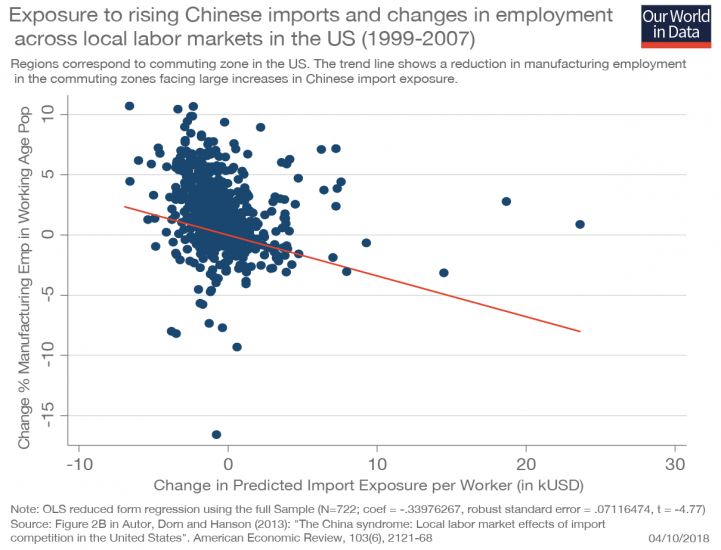
The visualization hither is one of the fundamental charts from their paper. Information technology's a besprinkle plot of cross-regional exposure to rising imports, against changes in employment. Each dot is a modest region (a 'commuting zone' to be precise). The vertical position of the dots represents the per centum alter in manufacturing employment for working age population; and the horizontal position represents the predicted exposure to rising imports (exposure varies across regions depending on the local weight of different industries).
The trend line in this chart shows a negative human relationship: more than exposure goes together with less employment. At that place are large deviations from the trend (at that place are some low-exposure regions with big negative changes in employment); but the paper provides more sophisticated regressions and robustness checks, and finds that this human relationship is statistically meaning.
This result is important because it shows that the labor market place adjustments were large. Many workers and communities were affected over a long period of time.9
Merely it's also important to keep in heed that Autor and colleagues are only giving us a partial perspective on the total effect of trade on employment. In detail, comparing changes in employment at the regional level misses the fact that firms operate in multiple regions and industries at the same time. Indeed, Ildikó Magyari recently found evidence suggesting the Chinese trade daze provided incentives for US firms to diversify and reorganize production.10
So companies that outsourced jobs to China ofttimes ended upwards endmost some lines of business organization, simply at the same fourth dimension expanded other lines elsewhere in the Usa. This means that chore losses in some regions subsidized new jobs in other parts of the land.
On the whole, Magyari finds that although Chinese imports may accept reduced employment within some establishments, these losses were more than first by gains in employment inside the same firms in other places. This is no alleviation to people who lost their job. But it is necessary to add together this perspective to the simplistic story of "trade with China is bad for US workers".
Exposure to ascension Chinese imports and changes in employment beyond local labor markets in the US (1999-2007) – Autor, Dorn and Hanson (2013)
Bear witness from the expansion of trade in India and the impact on poverty reductions
Another important paper in this field is Topalova (2010): "Factor immobility and regional impacts of trade liberalization: Testify on poverty from India".xi
In this newspaper Topalova looks at the impact of trade liberalization on poverty across different regions in India, using the sudden and all-encompassing change in Bharat's trade policy in 1991. She finds that rural regions that were more exposed to liberalization, experienced a slower pass up in poverty, and had lower consumption growth.
In the analysis of the mechanisms underlying this event, Topalova finds that liberalization had a stronger negative impact amongst the least geographically mobile at the bottom of the income distribution, and in places where labor laws deterred workers from reallocating beyond sectors.
The evidence from Bharat shows that (i) discussions that only look at "winners" in poor countries and "losers" in rich countries miss the point that the gains from trade are unequally distributed within both sets of countries; and (ii) context-specific factors, similar worker mobility across sectors and geographic regions, are crucial to empathize the impact of merchandise on incomes.
Evidence from other studies
- Donaldson (2018) uses archival data from colonial India to judge the bear on of Republic of india'southward vast railroad network. He finds railroads increased trade, and in doing so they increased real incomes (and reduced income volatility).12
- Porto (2006) looks at the distributional effects of Mercosur on Argentine families, and finds this regional trade agreement led to benefits across the entire income distribution. He finds the effect was progressive: poor households gained more than centre-income households, considering prior to the reform, trade protection benefitted the rich disproportionately.thirteen
- Trefler (2004) looks at the Canada-US Free Merchandise Understanding and finds at that place was a grouping who bore "adjustment costs" (displaced workers and struggling plants) and a group who enjoyed "long-run gains" (consumers and efficient plants). xiv
The link between trade and the price of living
The fact that trade negatively affects labor marketplace opportunities for specific groups of people does not necessarily imply that trade has a negative amass issue on household welfare. This is considering, while trade affects wages and employment, it also affects the prices of consumption goods. And so households are afflicted both as consumers and every bit wage earners.
Almost studies focus on the earnings channel, and effort to approximate the bear upon of trade on welfare by looking at how much wages can purchase, using as reference the irresolute prices of a stock-still basket of goods.
This arroyo is problematic because information technology fails to consider welfare gains from increased product variety, and obscures complicated distributional issues such as the fact that poor and rich individuals consume different baskets so they benefit differently from changes in relative prices.xv
Ideally, studies looking at the touch of merchandise on household welfare should rely on fine-grained data on prices, consumption and earnings. This is the approach followed in Atkin, Faber, and Gonzalez-Navarro (2018): "Retail globalization and household welfare: Prove from Mexico".sixteen
Atkin and coauthors utilise a uniquely rich dataset from Mexico, and find that the arrival of global retail chains led to reductions in the incomes of traditional retail sector workers, but had little impact on boilerplate municipality-level incomes or employment; and led to lower costs of living for both rich and poor households.
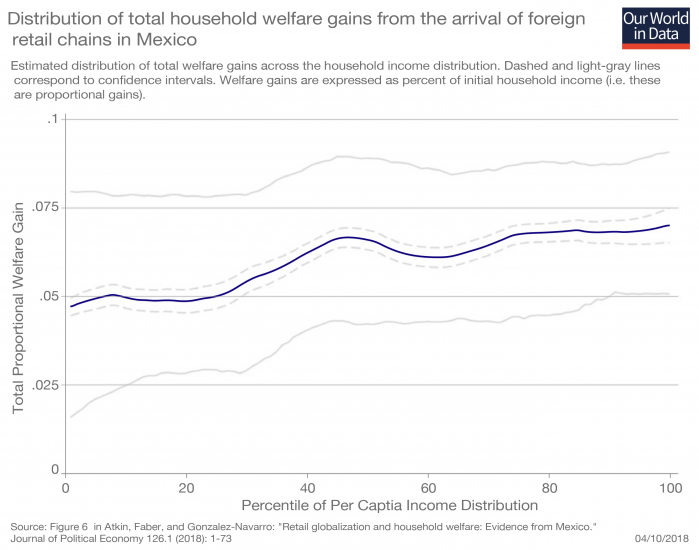
The chart here shows the estimated distribution of total welfare gains beyond the household income distribution (the low-cal-gray lines correspond to confidence intervals). These are proportional gains, and are expressed as percent of initial household income.
As nosotros can see, there is a net positive welfare effect beyond all income groups; but these improvements in welfare are regressive, in the sense that richer households gain proportionally more than (about 7.5 percent gain compared to 5 percent).17
Evidence from other countries confirms this is not an isolated instance – the expenditure channel really seems to be an important and understudied source of household welfare. Giuseppe Berlingieri, Holger Breinlich, Swati Dhingra, for example, investigate the consumer benefits from merchandise agreements implemented by the European union between 1993 and 2013; and they find that these trade agreements increased the quality of available products, which translated into a cumulative reduction in consumer prices equivalent to savings of €24 billion per year for European union consumers.xviii
Distribution of total household welfare gains from the arrival of foreign retail chains in Mexico – Atkin, Faber, and Gonzalez-Navarro (2018)
Wrapping up: Net welfare effects and implications
The available bear witness shows that, for some groups of people, trade has a negative effect on wages and employment opportunities; and at the aforementioned time information technology has a large positive issue via lower consumer prices and increased availability of products.
Two points are worth emphasising.
For some households, the internet effect is positive. Just for some households that'due south not the case. In detail, workers who lose their task can exist affected for extended periods of time, so the positive effect via lower prices is not enough to recoup them for the reduction in earnings.
On the whole, if we amass changes in welfare beyond households, the net upshot is usually positive. But this is hardly a consolation for those who are worse off.
This highlights a complex reality: There are amass gains from trade, but at that place are also existent distributional concerns. Even if trade is not a major driver of income inequalities, it's important to keep in mind that public policies, such as unemployment benefits and other safety-cyberspace programs, tin and should help redistribute the gains from trade.
The "2 waves of globalization"
The first "moving ridge of globalization" started in the 19th century, the 2d 1 afterwards WW2
The following visualization presents a compilation of available trade estimates, showing the evolution of world exports and imports equally a share of global economical output.
This metric (the ratio of full trade, exports plus imports, to global GDP) is known every bit the 'openness alphabetize'. The higher the alphabetize, the higher the influence of trade transactions on global economic activity.19
Equally we can see, until 1800 there was a long period characterized by persistently low international trade – globally the index never exceeded 10% before 1800. This and then changed over the course of the 19th century, when technological advances triggered a period of marked growth in world trade – the and so-chosen 'first wave of globalization'.
The first moving ridge of globalization came to an terminate with the beginning of the Kickoff World War, when the decline of liberalism and the rise of nationalism led to a slump in international merchandise. In the chart we see a big drop in the interwar catamenia.
Later on the Second World War trade started growing once more. This new – and ongoing – moving ridge of globalization has seen international merchandise grow faster than ever earlier. Today the sum of exports and imports across nations amounts to more than l% of the value of total global output.
(NB. Klasing and Milionis (2014), which is ane of the sources in the chart, published an boosted set of estimates under an alternative specification. Similarly, for the period 1960-2015, the World Depository financial institution's World Development Indicators published an culling set of estimates, which are like but non identical to those included from the Penn World Tables (nine.1). You discover all these alternative overlapping sources in this comparison chart.)
Before the beginning wave of globalization, trade was driven mostly past colonialism
Over the early mod menstruum, transoceanic flows of goods between empires and colonies accounted for an important part of international trade. The post-obit visualizations provides a comparison of intercontinental trade, in per capita terms, for unlike countries.
Every bit nosotros can encounter, intercontinental trade was very dynamic, with volumes varying considerably across fourth dimension and from empire to empire.
Leonor Freire Costa, Nuno Palma, and Jaime Reis, who compiled and published the original data shown here, argue that trade, as well in this period, had a substantial positive affect on the economy.xx
The first wave of globalization was marked by the rise and plummet of intra-European trade
The following visualization shows a detailed overview of Western European exports by destination. Figures correspond to export-to-GDP ratios (i.e. the sum of the value of exports from all Western European countries, divided past full Gdp in this region). Using the selection labeled 'relative', at the bottom of the chart, y'all tin can see the proportional contribution of each region to total Western European exports.
This chart shows that growth in Western European trade throughout the 19th century was largely driven by trade within the region: In the period 1830-1900 intra-European exports went from ane% of Gross domestic product to 10% of GDP; and this meant that the relative weight of intra-European exports doubled over the menstruum (in the 'relative' view you can see the changing limerick of exports by destination, and yous tin check that the weight of intra-European trade went from about one third to nigh two thirds over the period). But this process of European integration then complanate sharply in the interwar period.
Later on the Second World State of war trade within Europe rebounded, and from the 1990s onwards exceeded the highest levels of the first moving ridge of globalization. In addition Western Europe then started to increasingly trade with Asia, the Americas, and to a smaller extent Africa and Oceania.
The next graph, from Broadberry and O'Rourke (2010)21, shows another perspective on the integration of the global economy and plots the evolution of three indicators measuring integration across different markets – specifically goods, labor, and capital letter markets.
The indicators in this chart are indexed, so they evidence changes relative to the levels of integration observed in 1900. This gives us another viewpoint to sympathize how quickly global integration complanate with the ii World Wars.
(NB. Integration in the goods markets is measured here through the 'trade openness index', which is divers by the sum of exports and imports as share of GDP. In this interactive nautical chart you can explore trends in trade openness over this period for a selection of European countries.)
The second wave of globalization was enabled by technology
The world-wide expansion of trade after the 2nd World War was largely possible considering of reductions in transaction costs stemming from technological advances, such every bit the development of commercial civil aviation, the improvement of productivity in the merchant marines, and the democratization of the telephone as the main mode of advice. The visualization shows how, at the global level, costs beyond these three variables accept been going down since 1930.
The reductions in transaction costs had an affect, not only on the volumes of trade, simply likewise on the types of exchanges that were possible and profitable.
The offset wave of globalization was characterized by inter-industry trade. This ways that countries exported goods that were very different to what they imported – England exchanged machines for Australian wool and Indian tea. Equally transaction costs went downwards, this changed. In the second wave of globalization nosotros are seeing a rise in intra-industry trade (i.eastward. the exchange of broadly like appurtenances and services is condign more and more than common). France, for example, now both imports and exports machines to and from Federal republic of germany.
The following visualization, from the UN World Evolution Report (2009), plots the fraction of total world trade that is accounted for by intra-industry trade, by type of appurtenances. Every bit we can see, intra-industry merchandise has been going up for main, intermediate and last appurtenances.
This pattern of trade is of import because the scope for specialization increases if countries are able to substitution intermediate goods (e.g. auto parts) for related final goods (e.1000. cars).
Ii centuries of merchandise, country by land
Above we took a wait at the wide global trends over the final two centuries. Permit's now zoom in on state-level trends over this long and dynamic menstruation.
This chart plots estimates of the value of trade in goods, relative to full economical action (i.e. export-to-GDP ratios).
These historical estimates manifestly come with a large margin of error (in the measurement department below we hash out the data limitations); yet they offer an interesting perspective.
You tin can add more series by clicking on the selection ' Add country '. Each country tells a different story. If you add the Netherlands, for example, you will meet how important the Dutch Gold Age was.
(NB. Hither is the same chart but showing imports, rather than exports.)
Irresolute merchandise partners
In the next chart we plot, country by state, the regional breakdown of exports. Bharat is shown past default, but y'all tin can switch country using the choice 'Change entity'.
Using the option 'relative', at the bottom of the nautical chart, y'all can see the proportional contribution of purchases from each region. For example: We see that 48% of the total value of Indian exports in 2014 went to Asian countries.
This gives us an interesting perspective on the changing nature of trade partnerships. In India, nosotros come across the ascension importance of trade with Africa – this is a pattern that nosotros hash out in more detail below.
How much do countries trade?
Trade openness effectually the world
The so-called merchandise openness alphabetize is an economical metric calculated as the ratio of country's total trade (the sum of exports plus imports) to the country'due south gross domestic production.
This metric gives us an idea of integration, because it captures all incoming and outgoing transactions. The college the index the larger the influence of merchandise on domestic economic activities.
The visualization presents a globe map showing the trade openness index country by country. You lot can explore country-specific time series by clicking on a country, or by using the 'Chart' tab.
For any given yr, we see that there is a lot of variation across countries. The weight of trade in the The states economy, for case, is much lower than in other rich countries.
If you press the play button in the map, you can see changes over fourth dimension. This reveals that, despite the great variation betwixt countries, in that location is a common trend: Over the last couple of decades trade openness has gone up in well-nigh countries.
Exports and imports in existent dollars
Expressing trade values as a share of Gross domestic product tells united states of america the importance of merchandise in relation to the size of economic action. Let's at present accept a look at trade in monetary terms – this tells us the importance of trade in absolute, rather than relative terms.
The chart shows the value of exports (goods plus services) in dollars, country by country. All estimates are expressed in constant 2010 dollars (i.e. all values take been adjusted to correct for inflation).
The main takeaway here are the country-specific trends, which are positive and more pronounced than in the charts showing shares of Gross domestic product. This is not surprising: most countries today produce more than a couple of decades agone; and at the same time they merchandise more of what they produce.
Yous can plot trends by region using the option ' Add country '.
(NB. Hither is the same chart, merely showing imports rather than exports.)
What practice countries trade?
Trade in goods vs Trade in services
Trade transactions include goods (tangible products that are physically shipped across borders by route, rail, water, or air) and services (intangible commodities, such as tourism, financial services, and legal advice).
Many traded services make merchandise trade easier or cheaper—for example, shipping services, or insurance and fiscal services.
Trade in goods has been happening for millenia; while merchandise in services is a relatively recent phenomenon.
In some countries services are today an important driver of trade: In the UK services account for well-nigh 45% of all exports; and in the Bahama islands most all exports are services (about 87% in 2016).
In other countries the reverse is true: In Nigeria and Venezuela services accounted for around 2% and three% of exports, respectively, in 2014.
Globally, trade in goods accounts for the bulk of trade transactions. But equally this chart shows, the share of services in total global exports has increased, from 17% in 1979 to 24% in 2017.
(NB. This interactive nautical chart shows trade in services as share of GDP beyond countries and regions.)
Domestic vs Strange value added in exports
Firms around the world import goods and services, in order to utilise them equally inputs to produce appurtenances and services that are later exported. The imported goods and services incorporated in a land's exports are a key indicator of economic integration – they tell u.s.a. something about 'global value chains', where the different stages of the production procedure are located beyond different countries.
The chart, from UNCTAD's World Investment Written report 2018 – Investment and New Industrial Policies, shows trends of gross exports, broken down into domestic and strange value added. That is, the share of the value of exports that comes from foreign inputs.
Today, about 30% of the value of global exports comes from foreign inputs. In 1990, the share was near 25%.
Strange value added in trade peaked in 2010–2012 afterward two decades of continuous increase. This is consequent with the fact that, afterwards the global financial crisis, there has been a slowdown in the rate of growth of trade in goods and services, relative to global GDP. This is a sign that global integration stalled afterward the financial crunch.
(NB. The integration of global value chains is a common source of measurement mistake in trade data, because information technology makes it difficult to correctly attribute the origin and destination of goods and services. We discuss this in more item below.)
How are trade partnerships changing?
Bilateral trade is becoming increasingly common
If we consider all pairs of countries that appoint in merchandise around the world, we find that in the majority of cases, at that place is a bilateral relationship today: Most countries that export goods to a state, as well import goods from the same country.
The interactive visualization shows this.23
In this nautical chart, all possible country pairs are partitioned into three categories: the meridian portion represents the fraction of country pairs that practice not trade with one-another; the center portion represents those that trade in both directions (they export to i-another); and the bottom portion represents those that trade in one direction only (one country imports from, merely does non export to, the other country).
Equally nosotros can meet, bilateral trade is becoming increasingly mutual (the centre portion has grown substantially). But it remains true that many countries still do not trade with each other at all (in 2014 about 25% of all land-pairs recorded no trade).
Southward-South trade is condign increasingly of import
The visualization here shows the share of world merchandise trade that corresponds to exchanges between today's rich countries and the rest of the globe.
The 'rich countries' in this chart are: Australia, Austria, Belgium, Canada, Republic of cyprus, Kingdom of denmark, Finland, France, Deutschland, Hellenic republic, Iceland, Ireland, Israel, Italy, Nihon, Luxembourg, Netherlands, Kingdom of norway, Portugal, Spain, Sweden, Switzerland, U.k. and the U.s.a.. 'Non-rich countries' are all the other countries in the world.
As we can see, up until the Second World War the majority of merchandise transactions involved exchanges between this minor group of rich countries. Only this has been changing apace over the concluding couple of decades, and today trade between non-rich countries is just as important as trade between rich countries.
In the past 2 decades China has been a key commuter of this dynamic: the United nations Human Development Report (2013) estimates that betwixt 1992 and 2011, Communist china's trade with Sub-Saharan Africa rose from $1 billion to more than $140 billion.
(NB. Here is a stacked area chart showing the total composition of exports past partnership. It'south the same data, but plotted with stacked serial.)
The majority of preferential trade agreements are between emerging economies
The last few decades take not only seen an increment in the book of international merchandise, but also an increase in the number of preferential trade agreements through which exchanges take place. A preferential merchandise understanding is a trade pact that reduces tariffs between the participating countries for certain products.
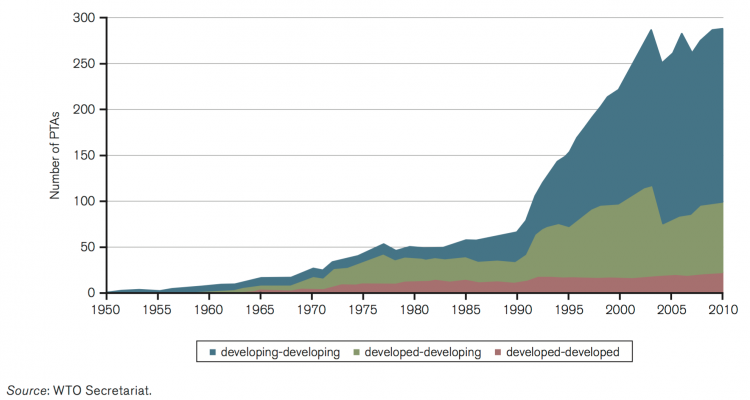
The visualization here shows the evolution of the cumulative number of preferential trade agreements that are in force across the earth, according to the Globe Merchandise Organization (WTO). These numbers include notified and non-notified preferential agreements (the source reports that only about two-thirds of the agreements currently in force have been notified to the WTO), and are disaggregated by land groups.
This figure shows the increasingly important office of merchandise between developing countries (South-South trade), vis-a-vis trade between developed and developing countries (North-South trade). In the tardily 1970s, North-South agreements accounted for more than half of all agreements – in 2010, they accounted for about one quarter. Today, the bulk of preferential merchandise agreements are between developing economies.
Number of preferential trade agreements in force by country group, 1950-2010 – Figure B1 in WTO Trade Report (2011)
Trading patterns accept been changing quickly in centre income countries
The increase in trade among emerging economies over the last half century has been accompanied by an important modify in the limerick of exported goods in these countries.
The next visualization plots the share of food exports in each country's full exported trade. These figures, produced by the Earth Bank, correspond to the Standard International Trade Nomenclature, in which 'food' includes, amongst other goods, live animals, beverages, tobacco, java, oils, and fats.
Two points stand out. First, at that place has been a substantial subtract in the relative importance of food exports since 1960s in most countries (although globally in the concluding decade it has gone up slightly). And second, this decrease has been largest in middle income countries, particularly in Latin America. Colombia is a notable case in signal: food went from 77% of merchandise exports in 1962, to 15.9% in 2015.
Regarding levels, as one would await, in high income countries food withal accounts for a much smaller share of trade exports than in most low- and middle-income-countries.
Explaining merchandise patterns: Theory and Bear witness
- Comparative advantage
- Trade diminishes with distance
- Institutions
- Increasing returns to scale
Comparative advantage
Theory: What is 'comparative reward' and why does it matter to understand trade?
In economical theory, the 'economic cost' – or the 'opportunity cost' – of producing a adept is the value of everything you need to give up in order to produce that good.
Economic costs include physical inputs (the value of the stuff yous use to produce the skillful), plus forgone opportunities (when you classify deficient resource to a task, you lot give up culling uses of those resources).
A country or a person is said to have a 'comparative advantage' if they have the ability to produce something at a lower opportunity toll than their trade partners.
The forgone opportunities of product are primal to understand this concept. It is precisely this that distinguishes accented advantage from comparative reward.
To see the difference between comparative and absolute advantage, consider a commercial aviation pilot and a baker. Suppose the pilot is an first-class chef, and she can broil merely as well, or even amend than the baker. In this case, the pilot has an absolute reward in both tasks. Withal the baker probably has a comparative advantage in baking, considering the opportunity cost of baking is much higher for the airplane pilot.
The freely bachelor economics textbook The Economy: Economic science for a Irresolute World explains this as follows: "A person or state has comparative reward in the production of a detail good, if the toll of producing an additional unit of that skillful relative to the cost of producing another good is lower than another person or country'due south cost to produce the aforementioned two goods."
At the private level, comparative advantage explains why you might want to consul tasks to someone else, even if yous can do those tasks better and faster than them. This may sound counterintuitive, simply it is not: If you are proficient at many things, information technology means that investing time in one task has a high opportunity toll, because you are not doing the other amazing things yous could be doing with your fourth dimension and resources. So, at least from an efficiency point of view, y'all should specialize on what you lot are best at, and delegate the balance.
The aforementioned logic applies to countries. Broadly speaking, the principle of comparative advantage postulates that all nations tin gain from trade if each specializes in producing what they are relatively more efficient at producing, and import the rest: "practice what you practise all-time, import the remainder".24
In countries with relative affluence of certain factors of production, the theory of comparative advantage predicts that they will export goods that rely heavily in those factors: a land typically has a comparative advantage in those goods that utilize more intensively its abundant resources. Colombia exports bananas to Europe because information technology has insufficiently abundant tropical conditions. Nether autarky, Colombia would find information technology cheap to produce bananas relative to east.k. apples.
Show: Is there empirical support for comparative-reward theories of merchandise?
The empirical prove suggests that the principle of comparative reward does help explicate trade patterns. Bernhofen and Brown (2004)25, for instance, provide evidence using the experience of Nihon. Specifically, they exploit Japan'southward dramatic nineteenth-century move from a state of near complete isolation to wide merchandise openness.
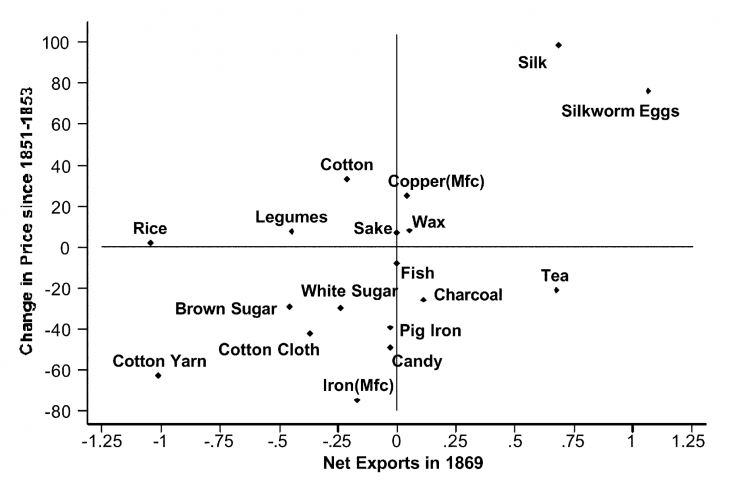
The graph here shows the toll changes of the primal tradable goods after the opening upwards to trade. It presents a scatter diagram of the net exports in 1869 graphed in relation to the alter in prices from 1851–53 to 1869. As we can see, this is consistent with the theory: after opening to merchandise, the relative prices of major exports such equally silk increased (Japan exported what was inexpensive for them to produce and which was valuable abroad), while the relative price of imports such as carbohydrate declined (they imported what was relatively more difficult for them to produce, but was cheap abroad).
Internet exports and price changes for 1869, Japan – Effigy 4 in Bernhofen and Brown (2014)26
Trade diminishes with distance
The resistance that geography imposes on trade has long been studied in the empirical economics literature – and the chief conclusion is that merchandise intensity is strongly linked to geographic altitude.
The visualization, from Eaton and Kortum (2002)27, graphs 'normalized import shares' confronting distance. Each dot represents a country-pair from a set of 19 OECD countries, and both the vertical and horizontal axis are expressed on logarithmic scales.
The 'normalized import shares' in the vertical axis provide a measure out of how much each country imports from different partners (run across the newspaper for details on how this is calculated and normalised), while distance in the horizontal axis corresponds to the distance between central cities in each country (come across the paper and references therein for details on the list of cities). Equally we can encounter, there is a strong negative relationship. Trade diminishes with distance. Through econometric modeling, the newspaper shows that this relationship is not just a correlation driven by other factors: their findings suggest that distance imposes a pregnant barrier to merchandise.
The fact that trade diminishes with distance is besides corroborated by data of trade intensity within countries. The visualization hither shows, through a series of maps, the geographic distribution of French firms that consign to France's neighboring countries. The colors reflect the pct of firms which export to each specific country. Every bit we can see, the share of firms exporting to each of the respective neighbors is largest close to the border. The authors likewise bear witness in the paper that this pattern holds for the value of private-firm exports – trade value decreases with altitude to the border.
Institutions
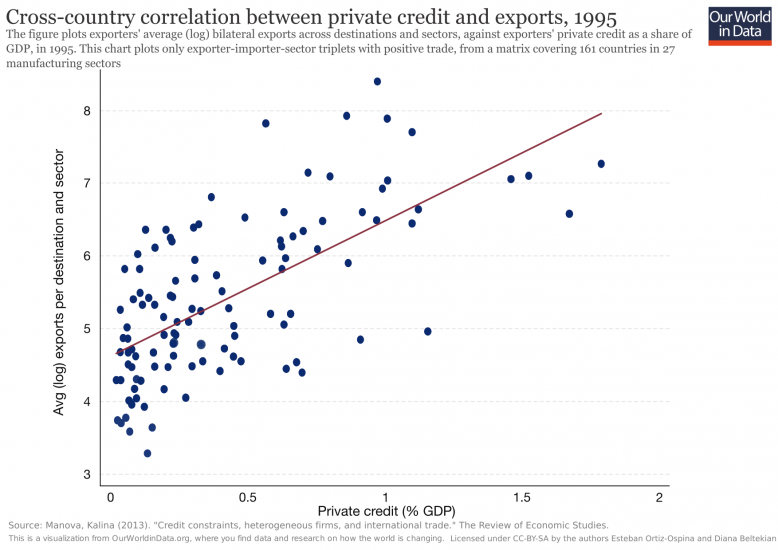
Conducting international trade requires both financial and not-fiscal institutions to support transactions. Some of these institutions are fairly obvious (east.chiliad. law enforcement); but some are less obvious. For case, the show shows that producers in exporting countries often need credit in gild to engage in trade.
The besprinkle plot, from Manova (2013)xxx, shows the correlation between levels in private credit (specifically exporters' private credit every bit a share of Gdp) and exports (average log bilateral exports across destinations and sectors). Every bit tin can be seen, financially developed economies – those with more dynamic private credit markets – typically outperform exporters with less evolved financial institutions.
Other studies accept shown that country-specific institutions, like the knowledge of foreign languages, for instance, are also important to promote foreign relative to domestic merchandise (see Melitz 200831).
Cross-land correlation between individual credit and exports – Figure two in Manova (2013)32
Increasing returns to calibration
The concept of comparative reward predicts that if all countries had identical endowments and institutions, then in that location would exist fiddling incentives for specialization, because the opportunity cost of producing whatsoever good would be the same in every country.
And then you may wonder: why is it then the case that in the last few years we accept seen such rapid growth in intra-industry trade between rich countries?
The increase in intra-industry between rich countries seems paradoxical under the lite of comparative reward, because in contempo decades nosotros accept seen convergence in key factors, such equally human majuscule, across these countries.
The solution to the paradox is really non very complicated: Comparative advantage is 1, just not the just forcefulness driving incentives to specialization and merchandise.
Several economists, almost notably Paul Krugman, have developed theories of merchandise in which merchandise is non due to differences between countries, just instead due to "increasing returns to scale" – an economic term used to denote a technology in which producing actress units of a proficient becomes cheaper if you operate at a larger calibration.
The idea is that specialization allows countries to reap greater economies of calibration (i.e. to reduce production costs past focusing on producing large quantities of specific products), and so trade can exist a adept idea even if the countries practice non differ in endowments, including culture and institutions.
These models of trade, frequently referred to as 'New Merchandise Theory', are helpful to explicate why in the terminal few years nosotros accept seen such rapid growth in two-way exchanges of goods inside industries between developed nations.
In a much cited paper, Evenett and Keller (2002)33 show that both cistron endowments and increasing returns help explain production and trade patterns around the world.
You can learn more than nearly New Merchandise Theory, and the empirical support behind it, in Krugman'south Nobel lecture.
At that place are dozens of official sources of information on international trade, and if yous compare these dissimilar sources, you will observe that they do not hold with one some other. Even if you focus on what seems to be the same indicator for the aforementioned yr in the same land, discrepancies are large.
For instance, for China in 2010, the estimated total value of goods exports was $ane.48 trillion according to World Bank Information, only it was $one.58 trillion co-ordinate to WTO Data. That's a difference of about 7%, or a hundred billion United states dollars.
Such differences between sources tin can also exist found for rich countries where statistical agencies tend to follow international reporting guidelines more closely. In Italy, for example, Eurostat figures of the value of exported goods in 2015 are 10% higher than the trade trade figures published by the OECD.
And at that place are also large bilateral discrepancies within sources. According to Imf data, for instance, the value of goods that Canada reports exporting to the US is nearly $20 billion more than that the value of goods that the US reports importing from Canada.
Here nosotros explicate how international trade data is collected and candy, and why at that place are such big discrepancies.
What data is available?
How large are discrepancies between sources?
In the visualization here we provide a comparison of the data published past several of the sources listed higher up, state by country, since 1955 upwards until today.
For each country, we exclude trade in services, and we focus only on estimates of the total value of exported appurtenances, expressed equally shares of GDP.37
Equally nosotros can clearly see in this chart, dissimilar information sources tell often very different stories. And this is truthful, to varying degrees, beyond all countries and years. Yous tin can utilise the option labeled 'change land', at the bottom of the chart, to focus on whatsoever land.
Constructing this chart was demanding. It required downloading trade information from many different sources, collecting the relevant series, then standardising them so that the units of measure and the geographical territories were consistent.
All series, except the 2 long-run series from CEPII and NBER-UN, were produced from data published by the sources in current US dollars, and so converted to Gross domestic product shares using a unique source (Earth Bank).38
And then, if all series are in the same units (share of national GDP), and they all measure the same matter (value of goods exported from ane country to the rest of the world), what explains the differences?
Allow's dig deeper to understand what's going on.
Why doesn't the data add up?
Differences in guidelines used by countries to record and report merchandise information
Broadly speaking, there are two main approaches used to approximate international merchandise trade:
- The outset approach relies on estimating trade from customs records, often complementing or correcting figures with information from enterprise surveys and administrative records associated with tax. The main manual providing guidelines for this arroyo is the International Merchandise Trade Statistics Manual (IMTS).
- The second approach relies on estimating trade from macroeconomic data, typically National Accounts. The principal manual providing guidelines for this approach is the Balance of Payments and International Investment Position Manual (BPM6), which was drafted in parallel with the 2008 Organization of National Accounts of the United Nations (SNA 2008). The idea behind this approach is recording changes in economic buying.39
Nether these two approaches, it is common to distinguish between 'traded merchandise' and 'traded goods'. The distinction is oft made because goods but existence transported through a land (i.e. goods in transit) are not considered to change the stock of cloth resource of a country, and are hence frequently excluded from the more than narrow concept of 'merchandise trade'.
Besides, adding to the complexity, countries often rely on measurement protocols that are developed alongside these approaches and concepts that are not perfectly uniform to begin with. In Europe, for example, countries utilise the 'Compilers guide on European statistics on international merchandise in goods'.
Measurement error and other inconsistencies
Even when two sources rely on the same broad accounting approach, discrepancies arise because countries neglect to adhere perfectly to the protocols.
In theory, for example, the exports of country A to land B should mirror the imports of country B from country A. But in practice this is rarely the case considering of differences in valuation. Co-ordinate to the BPM6, imports and exports should exist recorded in the balance of payments accounts on a 'free on board (Play tricks) basis', which means using prices that include all charges up to placing the appurtenances on board a ship at the port of deviation. Yet many countries stick to FOB values just for exports, and utilise CIF values for imports (CIF stands for 'Cost, Insurance and Freight', and includes the costs of transportation).40
The chart here gives you lot an thought of how big import-export asymmetries are. Shown are the differences betwixt the value of goods that each state reports exporting to the Usa, and the value of appurtenances that the US reports importing from the same countries. For case, for China, the figure in the chart corresponds to the "Value of merchandise imports in the Us from China" minus "Value of trade exports from Prc to the US".
The differences in the chart here, which are both positive and negative, suggest that there is more going on than differences in Trick vs CIF values. If all asymmetries were coming from CIF-Play a trick on differences, then we should merely see positive values in the nautical chart (recall that, unlike FOB values, CIF values include the cost of transportation, and then CIF values are larger).
What else is going on here?
Another common source of measurement error relates to the inconsistent attribution of merchandise partners. An example is failure to follow the guidelines on how to treat appurtenances passing through intermediary countries for processing or merchanting purposes. Every bit global product bondage go more complex, countries find it increasingly difficult to unambiguously institute the origin and final destination of merchandise, even when rules are established in the manuals. 41
And there are still more potential sources of discrepancies. For example differences in customs and taxation regimes, and differences between "general" and "special" trade systems (i.e. differences between statistical territories and bodily land borders, which do not often coincide considering of things like 'custom gratis zones').42
Fifty-fifty when two sources have identical merchandise estimates, inconsistencies in published data tin ascend from differences in exchange rates. If a dataset reports cross-state trade data in United states of america dollars, estimates will vary depending on the substitution rates used. Different exchange rates will atomic number 82 to conflicting estimates, even if figures in local currency units are consistent.
Wrapping up
Asymmetries in international trade statistics are large and they arise for a variety of reasons. These include conceptual inconsistencies across measurement standards, as well as inconsistencies in the fashion countries apply agreed protocols. Here's a checklist of problems to keep in mind when comparing sources.
- Differences in underlying records: is trade measured from National Accounts data rather than straight from custom or taxation records?
- Differences in import and export valuations: are transactions valued at Fox or CIF prices?
- Inconsistent attribution of trade partners: how is the origin and final destination of merchandise established?
- Difference between 'appurtenances' and 'merchandise': how are re-importing, re-exporting, and intermediary merchanting transactions recorded?
- Commutation rates: how are values converted from local currency units to the currency that allows international comparisons (nearly frequently the United states-$)?
- Differences between 'full general' and 'special' trade system: how is merchandise recorded for custom-free zones?
- Other issues: Fourth dimension of recording, confidentiality policies, production classification, deliberate misinvoicing for illicit purposes.
These factors have long been recognized by many organizations producing trade information. Indeed, international organizations often incorporate corrections, in an try to better information quality along these lines.
The OECD's Balanced International Merchandise Trade Statistics, for example, uses its own approach to right and reconcile international merchandise trade statistics.43
The corrections applied in the OECD's 'balanced' series make this the best source for cross-country comparisons. However, this dataset has depression coverage across countries, and information technology merely goes back to 2011. This is an of import obstacle, since the complex adjustments introduced by the OECD imply we can't easily improve coverage by appending data from other sources. At Our Earth in Data nosotros have chosen to rely on CEPII equally the main source for exploring long-run changes in international trade; but we besides rely on World Banking company and OECD data for up-to-engagement cantankerous-country comparisons.
At that place are two primal lessons from all of this. The get-go lesson is that, for about users of trade data out there, there is no obvious way of choosing between sources. And the 2d lesson is that, because of statistical glitches, researchers and policymakers should always take assay of trade data with a pinch of table salt. For example, in a recent high-profile study, researchers attributed mismatches in bilateral trade data to illicit fiscal flows through merchandise misinvoicing (or trade-based money laundering). Equally we evidence here, this interpretation of the data is not appropriate, since mismatches in the data can, and often do arise from measurement inconsistencies rather than malfeasance.44
Hopefully the give-and-take and checklist higher up can help researchers better interpret and choose betwixt conflicting data sources.
Data Sources
International Historical Statistics (past Brian Mitchell)
- Data: Aggregate trade (current value), bilateral trade with primary trading partners (current value), and major commodity exports past principal exporting countries. No data on trade as share of Gross domestic product is readily available.
- Geographical coverage: Countries around the world
- Time span: Long fourth dimension serial with annual observations – from 19th century up to today (2010)
- Bachelor at: The books are published in iii volumes covering more 5000 pages.45
At some universities you can access the online version of the books where information tables can be downloaded as ePDFs and Excel files. The online admission is here.
Penn Globe Tables
- Data: Real and PPP-adjusted GDP in U.s.a. millions of dollars, national accounts (household consumption, investment, authorities consumption, exports and imports), exchange rates and population figures.
- Geographical coverage: Countries around the world
- Time span: from 1950-2017 (version nine.i)
- Available at: Online here
- Feenstra, Robert C., Robert Inklaar and Marcel P. Timmer (2015), "The Next Generation of the Penn Earth Table" forthcoming American Economical Review, available for download at www.ggdc.net/pwt
Correlates of War Bilateral Merchandise
- Data: Total national merchandise and bilateral trade flows betwixt states. Total imports and exports of each land in current US millions of dollars and bilateral flows in current US millions of dollars
- Geographical coverage: Single countries around the earth
- Time bridge: from 1870-2009
- Available at: Online at www.correlatesofwar.org
- This information gear up is hosted past Katherine Barbieri, University of S Carolina, and Omar Keshk, Ohio State University. Authors note in their 'Moo-cow Trade Information Set Codebook': "We propose against using the dyadic data file to produce any national or global totals, based on aggregations of the partner merchandise."
World Bank – Globe Development Indicators
- Data: Trade (% of GDP) and many more specific series: trade in merchandise, trade in services, trade in high-technology, merchandise in ICT appurtenances, merchandise in ICT services – always exports and imports separately. Also consign and import value index and volume alphabetize.
- Geographical coverage: Countries and earth regions
- Time span: Annual since 1960
- Available at: Online at http://information.worldbank.org
Un Comtrade
- Information: Bilateral trade flows by article
- Geographical coverage: Countries around the earth
- Time span: 1962-2013
- Bachelor at: Online here
- Bilateral merchandise flows tin be sorted by goods or services, monthly or annually, with choice of classification (including HS codes, SITC, and BEC). Data is likely to exist very fourth dimension consuming to collate as there is no bulk information download unless a user has a premium site license.
UNCTADstat
- Data: Many different measures, including merchandise by volumes and value
- Geographical coverage: Countries around the world
- Fourth dimension bridge: For some serial, data is bachelor since 1948 – generally almanac, sometimes quarterly.
- Available at: Online here
- UNCTADstat reports export and import data between 1995 and 2016 simply primarily to different regional groupings than any one country, then it'due south probably not best suited to comparing land-to-country bilateral flows.
Eurostat – COMEXT
- Data: Merchandise flows (also by commodity)
- Geographical coverage: Europe (Eu and EFTA)
- Time span: Mostly since 1988
- Bachelor at: Online here
- As well, the Eurostat website 'Statistics Explained' publishes upwardly-to-appointment statistical information on international trade in goods and services.
World Trade Organization – WTO
- Data: Many series on tariffs and merchandise flows
- Geographical coverage: Countries effectually the world
- Time span: Since 1948 for some series
- Available at: Online hither
- The WTO offers a majority download of trade datasets which can exist found here. Amongst these are annual WTO merchandise trade values and WTO-UNCTAD-ITC annual trade in services datasets. The onetime is available from 1948 – 2017, workable, with very little additional formatting needed. All the same, observations are country groups, such as the EU28, the BRICS etc. rather than state-past-country values. Otherwise, the WTO'due south Statistics Database (SDB) has extensive fourth dimension series on international merchandise, by state with their trading partners. Again, trading partners are primarily restricted to country groupings rather than individual nations.
Fouquin and Hugot (CEPII 2016) – TRADHIST dataset
- Data: Many different data sets related to international trade, including trade flows by commodity geographical variables, and variables to approximate gravity models
- Geographical coverage: Countries effectually the world
- Available at: Online here
- TRADHIST Bilateral Trade Historical Serial: New Dataset 1827-2014 provides extensive dyadic trade data, with 97 percent of the observations from 1948 to today drawing on the IMF's Management of Trade Statistics (DOTS) dataset.
NBER-United Nations Trade Data, 1962-2000
- Data: Export and import values and volumes past commodity
- Geographical coverage: Single countries
- Fourth dimension span: 1962-2000
- Available at: Online here
- This data is also available from the Center for International Data. Bilateral merchandise data value estimates are very shut to that of the World Bank'due south imports of appurtenances and services time series.
Federico-Tena World Merchandise Historical Database
- Data: This website contains almanac series of trade by polity from 1800 to 1938 which sum as serial for continent and world.
- Geographical coverage: Countries around the globe
- Time bridge: 1800-1938
- Available at: Federico, K., Tena Junguito, A. (2016). World trade, 1800-1938: a new data-set. EHES Working Papers in Economic History, n. 93. Online here
Other historical trade data sets
- Information on UK bilateral trade for the time 1870-1913 was collected by David S. Jacks. It is downloadable in excel format here.
- For the time 1870-1913 21,000 bilateral trade observations tin be institute in Mitchener and Weidenmier (2008) – Trade and empire, available in the Economical Journal here.
- Information on UK, Deutschland, France, and US between mid-19th to 20th Century can exist found here.
- Information on Developing Country Export – in 1840, 1860, 1880 and 1900 – past John Hanson is bachelor here.
- Data onmerchandise between England and Africa during the period 1699-1808 is bachelor on the Dutch Data Archiving and Networked Services. Information technology was compiled by Marion Johnson.
pettiefackeffaced.blogspot.com
Source: https://ourworldindata.org/trade-and-globalization
0 Response to "Prior to Trade, What Was the Opportunity Cost to Produce 1 Clock in Denmark?"
Post a Comment